Chances are, if you’ve been pregnant and prepared for a vaginal delivery, you’ve heard of perineal massage. It’s usually recommended during late pregnancy to help prepare your tissues and pelvic floor muscles for a vaginal birth. And research shows it can be used during labor to reduce the risk of tearing and developing pain in the early postpartum.1 But its benefits don’t actually stop there. Postpartum perineal massage can play an important role in recovery by improving pelvic floor function and helping scar tissue heal more comfortably.
And that matters, because perineal tearing is incredibly common. According to the American Congress of Obstetricians and Gynecologists (ACOG), up to 79% of vaginal births involve some type of tear or episiotomy — including second-, third-, or fourth-degree tears — all of which can leave behind scar tissue in the perineum (the area between the vagina and anal sphincter).2 While scarring is part of normal healing, it can cause issues like tightness, pain with sex, or general discomfort if it doesn’t heal well.
Perineal scar massage, sometimes called vaginal massage, is a gentle technique that helps soften scar tissue, improve blood flow, and increase mobility. With the right timing and approach, it can make a noticeable difference in your comfort and pelvic floor function.
Why massage vaginal scar tissue?
Scar tissue forms as a natural response to wound healing — but it’s not a perfect replacement. Compared to healthy skin and muscle, scar tissue is often thicker, less elastic, and more sensitive. And it can tug on surrounding structures, irritate nearby nerves, and restrict blood flow in the vaginal area and perineum.
As a result, perineal scar tissue can lead to:
- Pain during or after sex3
- Itching, burning, or tightness in the vulva or near the vaginal entrance
- Discomfort with sitting or using the bathroom
- Incomplete bladder emptying or constipation
- General pelvic pain
But gentle, consistent scar massage may help increase blood flow, promote collagen remodeling, and desensitize irritated nerves. When done correctly, it can prevent chronic discomfort by improving tissue mobility before stiffness sets in.4,5
In other words, massage doesn’t just feel good — it can actually change how your scar heals and how your body feels long term.
When to start perineal scar massage
Perineal scar massage is a great way to reconnect with your body after birth — and it’s easy to get started, but timing matters. While your body needs time to heal initially, starting perineal scar massage within the right window can support better recovery and reduce long-term discomfort.
Most scar tissue changes — like improved flexibility and reduced thickness — happen within the first 1–2 years postpartum, so it’s worth beginning sooner rather than later. Still, perineal scar massage should wait until tissues are fully healed to avoid re-injury or infection. Most people can begin around 6 weeks postpartum, once cleared by their provider.
Here’s a general timeline:
- Weeks 1 to 4: Prioritize rest, hygiene, and gentle care. Avoid internal touch. Use sitz baths, ice, and light movement or pelvic floor exercises to support healing.
- Weeks 4 to 5: You can usually begin gentle external desensitization during this time. Lightly touch your skin around your scar — either in the shower or over underwear — to help reduce sensitivity.
- Week 6 and beyond: Once cleared by your healthcare provider, you can begin massaging the perineal scar directly (both on the outside and inside. See below for these how-to details!
Pro tip: V-Hive’s online pelvic floor healing resources offer expert-backed guidance for navigating these early weeks of recovery. If you’ve had a more significant tear (second-, third-, or fourth-degree) or are still experiencing discomfort, extra support can help. The V-Hive’s online pelvic floor healing resources offer expert-backed guidance for navigating these early weeks of recovery.
How to do perineal scar massage
Before you begin:
- Wash your hands with thoroughly warm water and soap
- Use a hypoallergenic oil or water-based lubricant
- Find a comfortable, private space
- Consider using a mirror for better visibility
When to wait or skip massage:
Perineal massage is generally safe once your tissues have healed and your provider has cleared you from pelvic rest. However, pause or avoid massage if:
- You’re less than 6 weeks postpartum
- You still have visible stitches, scabs, or an unhealed incision
- You’re on pelvic rest
- You have a vaginal infection or active herpes outbreak
- You experience severe pain, new bleeding, or your scar reopens
- You feel dizzy, faint, short of breath, or anxious during massage
Always start gently and stop if something feels off. If you’re unsure, check in with your healthcare provider or pelvic floor physical therapist before continuing.
Perineal scar tissue massage: Step-by-step
Here’s a safe, easy-to-follow routine to massage the area around your perineal scar:
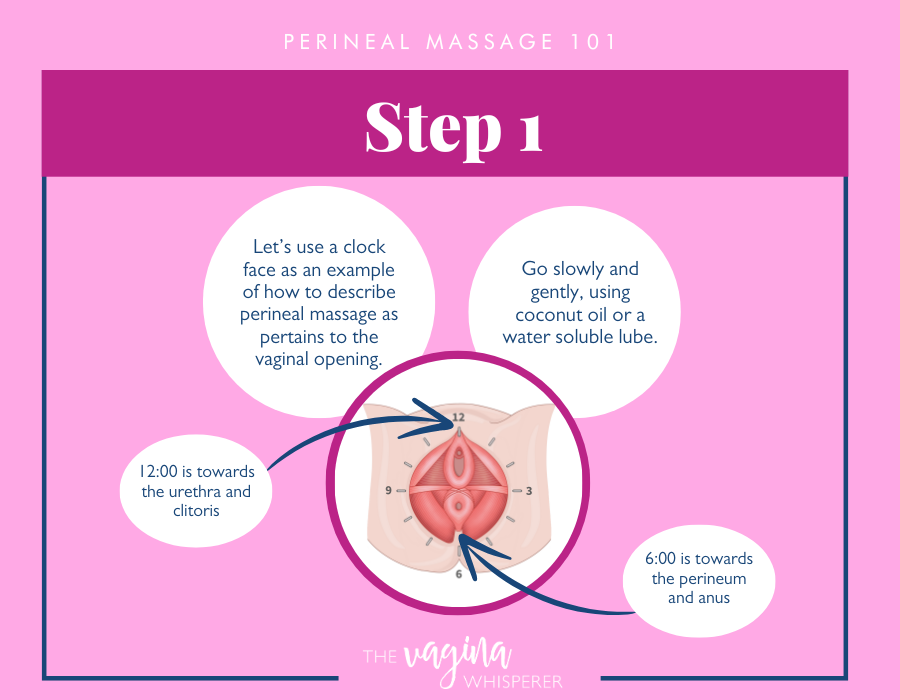
Start by orienting yourself with the area that you’ll be massaging. Think of your vaginal opening as a clock face: At the top of your vaginal entrance (toward your clitoris) is 12 o’clock. Down toward your anus is the 6 o’clock position. To the right and left sides of your vaginal entrance are the 3 and 9 o’clock positions.
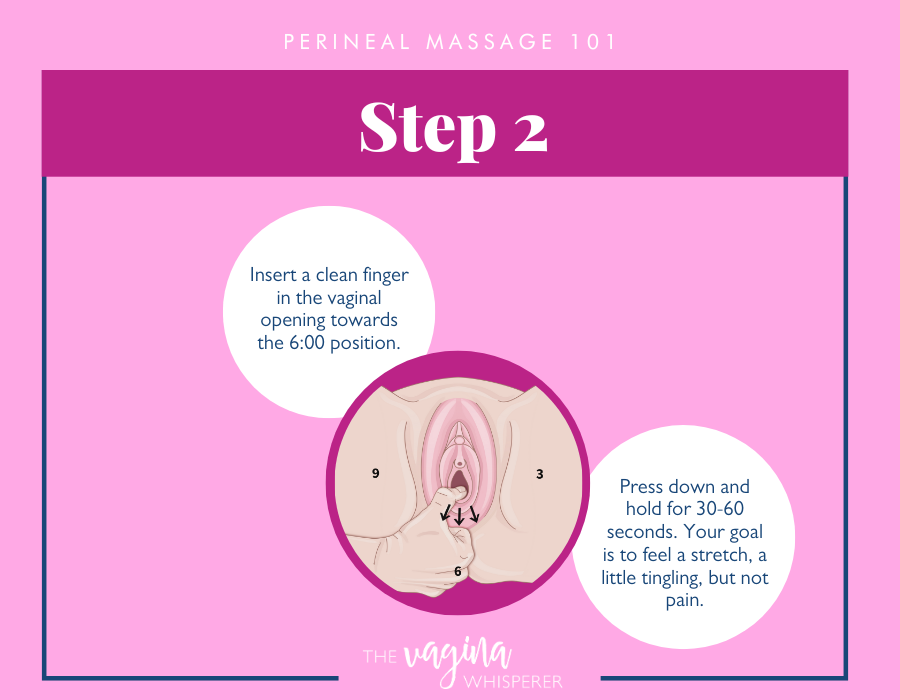
Insert your index finger or thumb about 1 inch into your vaginal opening (experiment with which finger feels best). Gently press downward until you feel a stretch or slight tingling sensation. Hold for 30 to 60 seconds. Stop if you feel sharp pain.
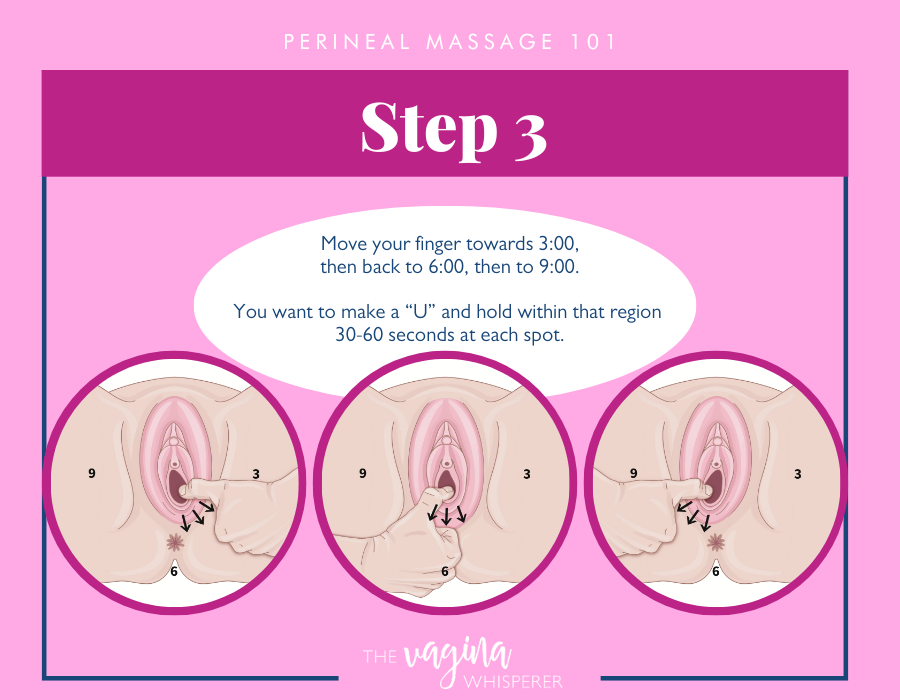
Now, swoop your finger along in the bottom half of your vaginal entrance in the shape of a “U.” Move from 6 to 3 o’clock, pausing to hold light pressure. Then swoop back to 9 o’clock and pause to hold light pressure. Stop if you feel sharp pain.
To widen the vaginal opening, insert a second finger. Gently stretch both fingers away from each other until you feel a stretch/slight tingling sensation in the 3 and 6 o’clock positions and 6 and 9 o’clock positions. Hold each stretch for 30 to 60 seconds. Stop if you feel sharp pain.
Continue these steps for 1 to 5 minutes. You can do perineal scar massage daily or every-other-day, depending on how you’re feeling.
Massage tips:
To get the most out of your perineal scar massage, follow these tips:
- During perineal massage, you should feel a moderate stretch to a slight tingling of the tissues. But you should not feel a sharp pain. Stop if this is your experience.
- Start slow and be consistent.
- Use breathwork to help relax the pelvic floor muscles.
- If your scar feels too tender, begin externally and gradually increase pressure over time.
Ready to Feel Better After Birth? Support Your Healing with the V-Hive
Perineal scar massage is a simple, effective way to ease discomfort, improve mobility, and reconnect with your body after birth. Whether you’re recovering from a second-degree tear, episiotomy, or just feeling tension in the perineal area, this hands-on technique can help you heal more fully and confidently.
If you need more support, or have pelvic floor symptoms like bladder leaks, constipation, or pain during sex, it can help to get more support. Join the V-Hive to access expert-led postpartum and pelvic floor recovery programs. From step-by-step healing routines to strength-building and relaxation, we’ve got the tools to support your postpartum body — no matter where you’re starting from. Get started with a free 7-day trial and take the first step toward feeling better today.
References
- Venugopal, V., et al. (2022). Perineal massage for prevention of perineal trauma and episiotomy during labor: A systematic review and meta-analysis. Journal of Family & Reproductive Health.
- American College of Obstetricians and Gynecologists. (2016). Ob-gyns can prevent and manage obstetric lacerations during vaginal delivery, says new ACOG Practice Bulletin.
- Gommesen, D., et al. (2019). Obstetric perineal tears, sexual function and dyspareunia among primiparous women 12 months postpartum: A prospective cohort study. BMJ Open.
- Deflorin, C., et al. (2020). Physical management of scar tissue: A systematic review and meta-analysis. Journal of Alternative and Complementary Medicine.
- Scott H.C., et al. (2022). Is massage an effective intervention in the management of post-operative scarring? A scoping review. J Hand Ther.